








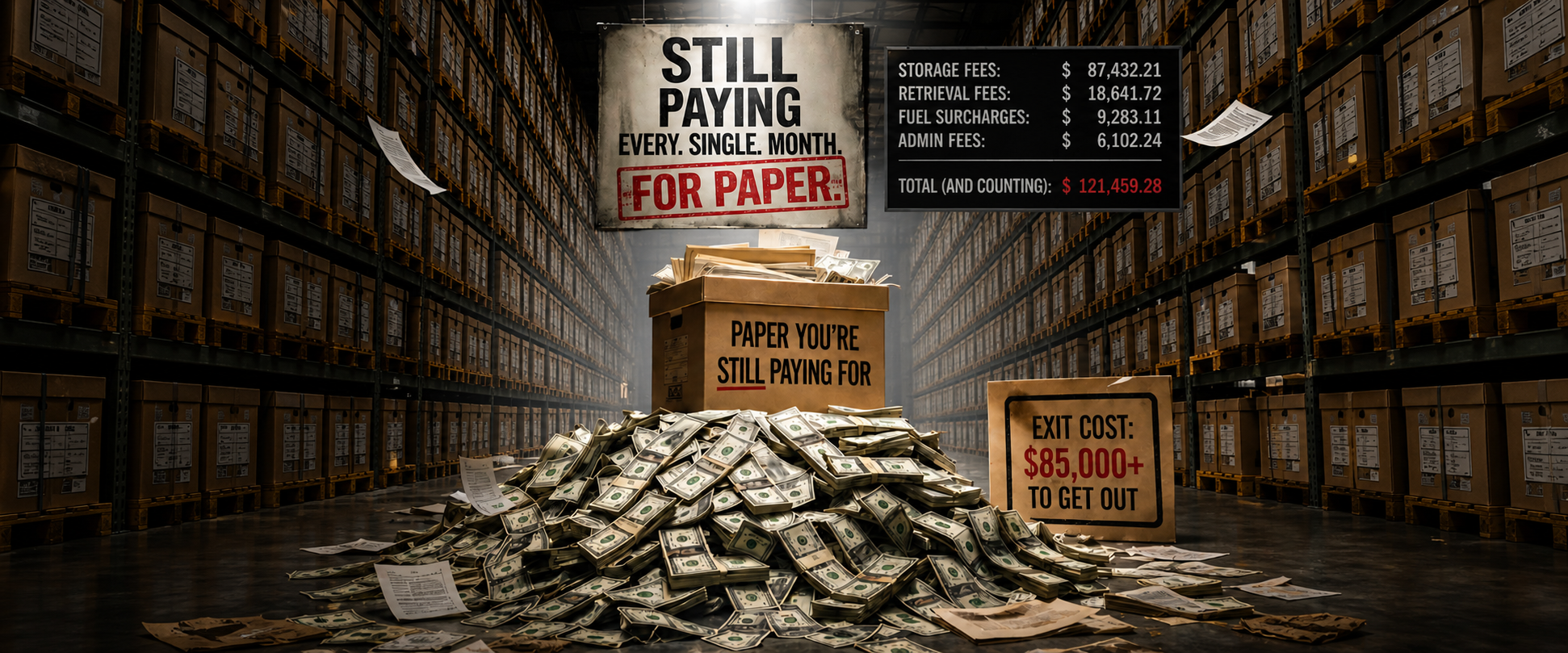
If you’re paying to store paper, you’re not just storing it—you’re paying for it over and over again.
Monthly storage fees. Boxes sitting somewhere offsite. Rows of filing cabinets taking up space in your office. Records you rarely access—but can’t get rid of.
And even when companies want to move away from it, they often run into another challenge: the cost to get out.
It’s not just storage—it’s a system that keeps you paying.
So instead, the boxes stay where they are—and the monthly charges keep coming, month after month.
The Costs Add Up Faster Than You Think
At first glance, storage doesn’t always feel like a major expense. It’s a monthly fee. It’s predictable. It’s “just part of doing business.”
But when you take a closer look, the costs go far beyond that base number.
It’s not just storage—it’s everything around it:
- Monthly storage fees that never really go away
- Retrieval fees every time you need a document
- Fuel or service surcharges
- Administrative fees tied to managing your records
And those costs don’t stay flat.
They accumulate.
In many cases, businesses end up spending tens—or even hundreds of thousands of dollars over time just to store information they rarely use.
At a certain point, it’s not just a storage expense—it becomes an ongoing operational cost that’s hard to control and even harder to eliminate.
The Hidden Barrier: Why Businesses Stay Stuck
Most businesses don’t want to keep paying for storage forever.
They just don’t see a clear way out.
Because getting out often comes with a price.
Large-scale retrieval, handling, and exit costs can add up quickly—sometimes reaching tens of thousands of dollars or more. And when faced with that kind of upfront cost, many organizations make the same decision: We’ll deal with it later.
So the boxes stay where they are.
And the monthly costs continue.
Not because it’s the best option—but because it feels like the easiest one in the moment.
It Doesn’t Have to Be All at Once—Or All Upfront
One of the biggest misconceptions about moving away from paper storage is that it has to be an all-or-nothing decision.
It doesn’t.
And more importantly—it doesn’t have to be a single, large upfront expense.
A more practical approach is to move forward in phases.
Instead of pulling everything at once, you can:
- Focus on the documents you actually use
- Prioritize what’s costing you the most
- Digitize in stages over time
This allows you to spread the cost out, while still making meaningful progress.
It also changes the conversation—from “we can’t afford to get out” to “we can start reducing this now.”
It’s Not Just Offsite—It’s In Your Office Too
Even for businesses that keep some records onsite, paper still comes at a cost.
Filing cabinets, storage rooms, and boxed records take up valuable office space—space that could be used for people, productivity, or growth.
And that space isn’t free.
At the same time, having documents onsite doesn’t necessarily make them easier to use.
In many cases, it creates a different kind of challenge:
- Files get misfiled or duplicated
- Cabinets become overfilled and disorganized
- Different departments store information in different ways
- Employees spend time searching instead of working
What should take seconds often turns into minutes—or longer.
And when that happens across a team, every day, it adds up.
So whether your records are offsite or in your office, the issue is the same: paper makes information harder to access, harder to manage, and more expensive to maintain.
How Scanning Changes the Equation
This is where document scanning and conversion services start to shift things.
Instead of trying to tackle everything at once, you can take a targeted, practical approach:
- Scan what you actually use
- Make those documents searchable so they can be found instantly
- Begin reducing your reliance on physical storage
This approach does more than just reduce paper—it improves how your business functions day to day.
Information becomes easier to find.
Teams spend less time searching.
And the dependency on storage—both offsite and in-office—starts to decrease.
Over time, that shift builds momentum.
From Storage Costs to Cost Control
As you begin to digitize your documents:
- Ongoing storage costs start to decrease
- Retrieval fees become less frequent
- Time spent searching for information is reduced
- Office space can be used more effectively
And gradually, something important happens: You move from reacting to storage costs… to actually controlling them.
And eventually, you stop paying for it altogether.
Where ECM Fits (Without Overcomplicating It)
As more documents are digitized, many businesses begin looking at ways to better organize and manage them.
That’s where tools like Enterprise Content Management can support the process—helping teams store, search, and work with documents more efficiently.
But the first step isn’t implementing a system.
It’s getting your documents out of paper and into a usable format.
Where to Start
If you’re currently paying for offsite storage—or managing large volumes of paper internally—the first step isn’t to digitize everything.
It’s to understand:
- What you have
- What you actually use
- Where the biggest costs and inefficiencies exist
From there, you can build a plan that works for your business—without disrupting operations or taking on everything at once.
The goal isn’t to eliminate paper overnight. It’s to start reducing the cost of keeping it.
You don’t have to keep paying for storage just because it’s always been there.
Explore how a Scan-to-Zero approach helps you move away from storage—without taking on the full cost upfront →
Related Document Workflow Solutions
Enterprise Content Management
Organize, manage, and securely access business documents and information from one connected system.
Document Management Systems
Improve accessibility, reduce paper dependency, and simplify how documents move through your business.
Conversion Services
Digitize paper records and legacy documents to improve access, storage, and workflow efficiency.
Business Process Automation
Reduce manual tasks and streamline repetitive document-driven workflows across your organization.
Document Workflow Assessments
Identify bottlenecks, inefficiencies, and opportunities to improve how information moves through your business.
Start Here →
Not sure where to begin? Start the conversation and we’ll help point you in the right direction.
Paper Storage FAQs
What are the hidden costs of paper storage?
Paper storage costs often include monthly offsite storage fees, retrieval charges, staff time spent locating files, physical office space, and long-term document management expenses.
What is a Scan-to-Zero approach?
A Scan-to-Zero approach helps businesses reduce or eliminate ongoing paper storage by digitizing records and creating searchable digital access to documents.
Why are businesses digitizing paper records?
Businesses digitize records to improve accessibility, reduce storage costs, increase efficiency, support remote work, and improve document security.
